52 Club · 11. 不是另一個讀書會
2049:未來10000天的可能用九組外部證據,重新檢視未來判斷
這一篇把書中的未來想像放回研究與現實資料中檢查:哪些方向已有支持、哪些還缺少條件,以及哪些判斷必須隨新證據更新。
Guided Reading
一次閱讀一個觀點
先看總圖,再依照下方編號逐頁閱讀。每次只顯示目前選取的圖片與解說。
主題總圖
九組外部證據,讓 2049 的想像接受現實檢查
主題總圖
未來想像要能幫助決策,不能只看敘事是否動人。這一篇從預測、生產力、AI 能力、空間運算、隱私、平台治理、生成內容、教育醫療與基因資料九個方向,逐一檢查證據與限制。
- 先看證據|目前真正觀察到什麼
- 再看限制|哪些結論還不能成立
- 最後看更新|什麼新訊號會改變判斷
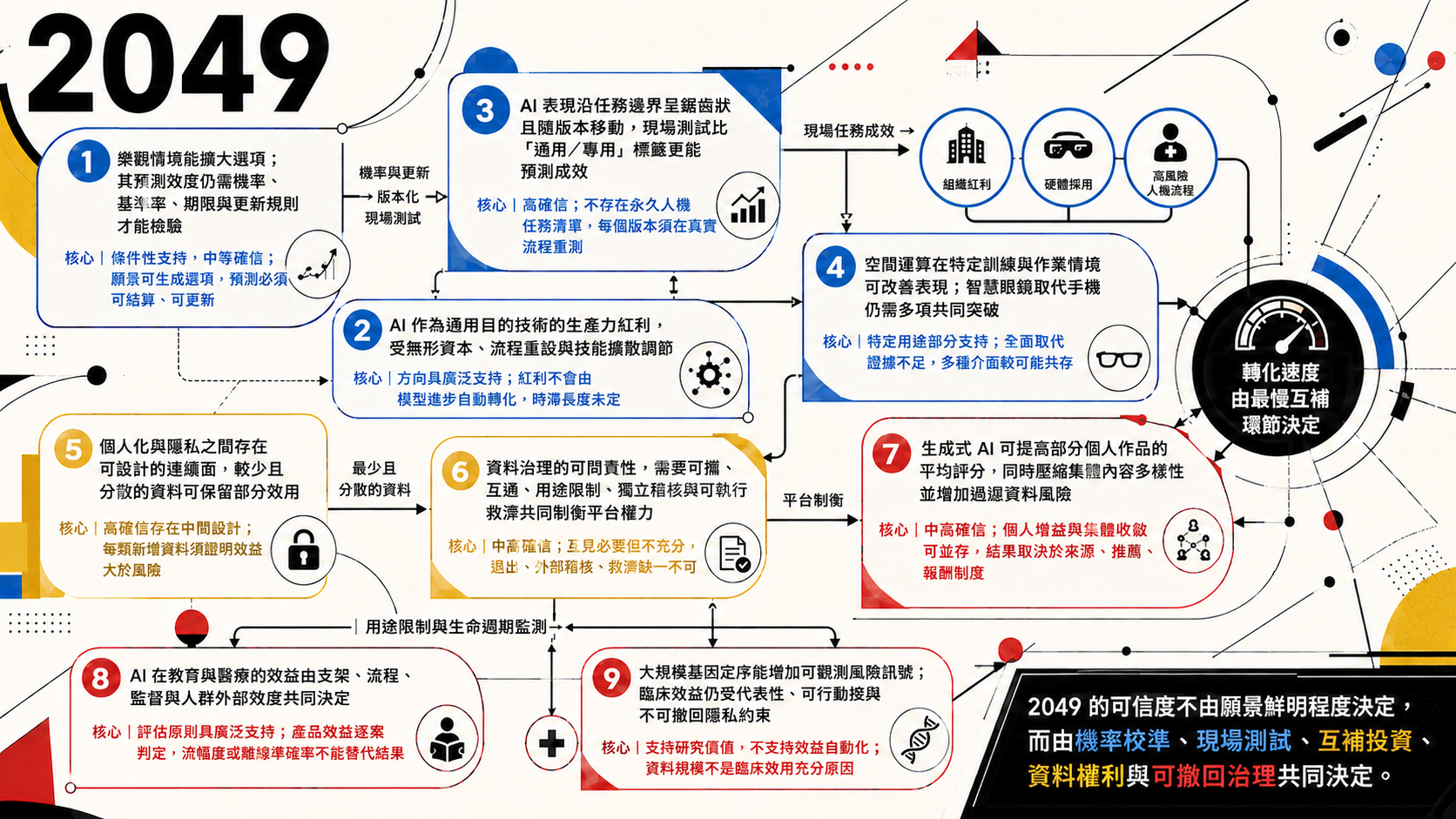 點圖開啟原尺寸
讀完後的三個檢查
九項外部檢查共同指出:多數方向並非全對或全錯,而是取決於流程、配套、使用情境與治理。更可靠的做法,是把判斷寫成有條件、可追蹤、會隨證據更新的版本。
證據目前支持到什麼程度?
條件還缺少哪些配套與適用邊界?
更新什麼結果出現時,我應該改變判斷?
Sources
參考資料
文中的編號可點擊查看;此處保留本篇實際使用的完整來源。
- [1]
凱文・凱利著、吳晨編,《2049:未來10000天的可能》,中信出版集團,2025,ISBN 978-7-5217-7518-1。本文分析之附件版本。
來源為本文分析附件 - [5]
Mellers et al., “Psychological Strategies for Winning a Geopolitical Forecasting Tournament,” Psychological Science, 2014.
來源 ↗ - [10]
Brynjolfsson, Rock & Syverson, “The Productivity J-Curve,” American Economic Journal: Macroeconomics, 2021.
來源 ↗ - [15]
European Union, General Data Protection Regulation, 2016.
來源 ↗ - [16]
Court of Justice of the European Union, C-394/23 judgment on data minimisation, 2025.
來源 ↗ - [17]
NIST, “Privacy-Preserving Federated Learning” and PETs Testbed, 2025–2026.
來源 ↗ - [22]
Brynjolfsson, Li & Raymond, “Generative AI at Work,” Quarterly Journal of Economics, 2025.
來源 ↗ - [23]
Noy & Zhang, “Experimental Evidence on the Productivity Effects of Generative Artificial Intelligence,” Science, 2023.
來源 ↗ - [25]
Kestin et al., “AI Tutoring Outperforms In-Class Active Learning,” Scientific Reports, 2025.
來源 ↗ - [26]
OECD, Digital Education Outlook 2026, 2026.
來源 ↗ - [27]
UNESCO, Guidance for Generative AI in Education and Research, 2023.
來源 ↗ - [28]
World Health Organization, Ethics and Governance of Artificial Intelligence for Health: Guidance on Large Multi-Modal Models, 2025.
來源 ↗ - [29]
U.S. Food and Drug Administration, “Artificial Intelligence-Enabled Device Software Functions: Lifecycle Management,” draft guidance, 2025.
來源 ↗ - [33]
World Health Organization, Human Genome Editing: A Framework for Governance, 2021.
來源 ↗ - [36]
European Commission, “How the DMA Is Making Smartphones Better,” 2026.
來源 ↗ - [42]
NIST, AI RMF Generative Artificial Intelligence Profile, AI 600-1, 2024.
來源 ↗ - [44]
Börjeson et al., “Scenario Types and Techniques: Towards a User’s Guide,” Futures, 2006.
來源 ↗ - [45]
Meissner & Wulf, “Cognitive Benefits of Scenario Planning,” Technological Forecasting and Social Change, 2013.
來源 ↗ - [46]
Mellers et al., “Identifying and Cultivating Superforecasters,” Perspectives on Psychological Science, 2015.
來源 ↗ - [47]
Dell’Acqua et al., “Navigating the Jagged Technological Frontier,” Organization Science, 2026.
來源 ↗ - [48]
Liang et al., “Holistic Evaluation of Language Models,” Transactions on Machine Learning Research, 2023.
來源 ↗ - [49]
Becker et al., “Measuring the Impact of Early-2025 AI on Experienced Open-Source Developer Productivity,” preprint, 2025.
來源 ↗ - [50]
Xiong et al., “Augmented Reality and Virtual Reality Displays,” Light: Science & Applications, 2021.
來源 ↗ - [51]
Koutromanos & Kazakou, “Augmented Reality Smart Glasses Use and Acceptance,” Computers & Education: X Reality, 2023.
來源 ↗ - [52]
Wang et al., “Integrating AI-Powered Smart Glasses into Digital Health Management,” npj Digital Medicine, 2025.
來源 ↗ - [53]
Baruh, Secinti & Cemalcilar, “Online Privacy Concerns and Privacy Management,” Journal of Communication, 2017.
來源 ↗ - [54]
Nouwens et al., “Dark Patterns after the GDPR,” CHI, 2020.
來源 ↗ - [55]
Selbst et al., “Fairness and Abstraction in Sociotechnical Systems,” FAccT, 2019.
來源 ↗ - [56]
UK Competition and Markets Authority, AI Foundation Models: Update Paper, 2024.
來源 ↗ - [57]
Doshi & Hauser, “Generative AI Enhances Individual Creativity but Reduces the Collective Diversity of Novel Content,” Science Advances, 2024.
來源 ↗ - [58]
Shumailov et al., “AI Models Collapse When Trained on Recursively Generated Data,” Nature, 2024.
來源 ↗ - [59]
Bastani et al., “Generative AI without Guardrails Can Harm Learning,” PNAS, 2025.
來源 ↗ - [60]
Wang et al., “The Global State of Clinical Evidence for Artificial Intelligence in Health,” npj Digital Medicine, 2026.
來源 ↗ - [61]
Vasey et al., “DECIDE-AI: Reporting Guideline for Early-Stage Clinical Evaluation of Decision Support Systems Driven by AI,” Nature Medicine, 2022.
來源 ↗ - [62]
Martin et al., “Clinical Use of Current Polygenic Risk Scores May Exacerbate Health Disparities,” Nature Genetics, 2019.
來源 ↗ - [63]
Smith et al., “The BabySeq Project: A Clinical Trial of Genome Sequencing in a Diverse Cohort of Infants,” American Journal of Human Genetics, 2024.
來源 ↗ - [64]
Holm et al., “The BabySeq Project: Implementing Genomic Sequencing in Newborns,” BMC Pediatrics, 2018.
來源 ↗
同系列閱讀
也可以從其他角度繼續閱讀
以下文章彼此獨立,沒有固定閱讀順序;選擇現在最感興趣的角度即可。
Keep Exploring
讀完這一篇,繼續探索下一個問題。
帶著剛剛形成的觀點,看看下一個主題會打開什麼新的視角。