
52 Club · 11. 不是另一個讀書會
2049:未來10000天的可能把未來想像,轉成九項可行動的選擇
這一篇把願景與外部證據整合成可執行的治理方法:如何設計責任、授權、資料鏈、里程碑與停止條件,讓長期投入仍保有學習與轉向空間。
Guided Reading
一次閱讀一個觀點
先看總圖,再依照下方編號逐頁閱讀。每次只顯示目前選取的圖片與解說。
主題總圖
從願景到行動:九項能檢驗、能調整的治理方法
主題總圖
面對 2049,不必在全盤相信與全盤否定之間二選一。這一篇把前面的想像與證據轉成九項治理方法,讓每一次投入都能說清楚條件、責任、觀察指標與退出方式。
- 先定條件|願景要在什麼情況下成立
- 再定責任|誰能決定、誰承擔風險
- 保留退路|用里程碑、開放介面與獨立評估持續修正
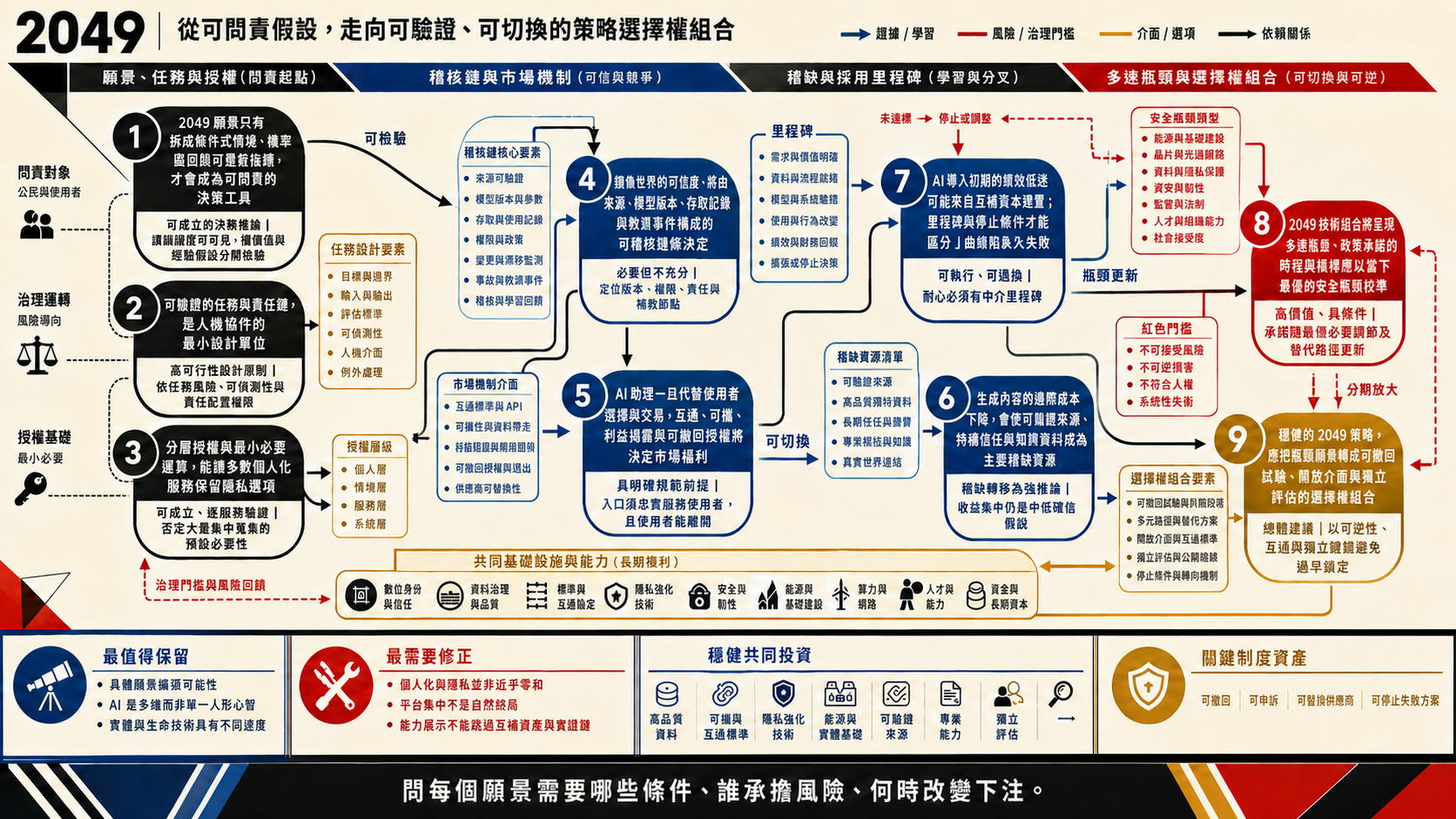 點圖開啟原尺寸
讀完後的三個檢查
九項治理方法的共同目的,是把不可驗證的樂觀敘事,轉成分期、可觀察、可申訴也可停止的行動。願景仍然重要,但它必須接受證據、責任與退出條件的約束。
條件成功與失敗要如何判定?
責任誰能申訴、停止或更換方案?
選擇下一步是否仍保留替代路徑?
Sources
參考資料
文中的編號可點擊查看;此處保留本篇實際使用的完整來源。
- [3]
UK Government Office for Science, “The Futures Toolkit,” 2024.
來源 ↗ - [4]
OECD, Foresight Toolkit for Resilient Public Policy, 2025.
來源 ↗ - [5]
Mellers et al., “Psychological Strategies for Winning a Geopolitical Forecasting Tournament,” Psychological Science, 2014.
來源 ↗ - [10]
Brynjolfsson, Rock & Syverson, “The Productivity J-Curve,” American Economic Journal: Macroeconomics, 2021.
來源 ↗ - [15]
European Union, General Data Protection Regulation, 2016.
來源 ↗ - [17]
NIST, “Privacy-Preserving Federated Learning” and PETs Testbed, 2025–2026.
來源 ↗ - [18]
NIST, Reducing Risks Posed by Synthetic Content, 2024.
來源 ↗ - [19]
Coalition for Content Provenance and Authenticity, C2PA Technical Specification 2.4, 2025.
來源 ↗ - [20]
U.S. Copyright Office, Copyright and Artificial Intelligence, 2024–2025.
來源 ↗ - [22]
Brynjolfsson, Li & Raymond, “Generative AI at Work,” Quarterly Journal of Economics, 2025.
來源 ↗ - [23]
Noy & Zhang, “Experimental Evidence on the Productivity Effects of Generative Artificial Intelligence,” Science, 2023.
來源 ↗ - [32]
International Energy Agency, Energy and AI, 2025.
來源 ↗ - [33]
World Health Organization, Human Genome Editing: A Framework for Governance, 2021.
來源 ↗ - [36]
European Commission, “How the DMA Is Making Smartphones Better,” 2026.
來源 ↗ - [47]
Dell’Acqua et al., “Navigating the Jagged Technological Frontier,” Organization Science, 2026.
來源 ↗ - [49]
Becker et al., “Measuring the Impact of Early-2025 AI on Experienced Open-Source Developer Productivity,” preprint, 2025.
來源 ↗ - [50]
Xiong et al., “Augmented Reality and Virtual Reality Displays,” Light: Science & Applications, 2021.
來源 ↗ - [56]
UK Competition and Markets Authority, AI Foundation Models: Update Paper, 2024.
來源 ↗ - [57]
Doshi & Hauser, “Generative AI Enhances Individual Creativity but Reduces the Collective Diversity of Novel Content,” Science Advances, 2024.
來源 ↗ - [58]
Shumailov et al., “AI Models Collapse When Trained on Recursively Generated Data,” Nature, 2024.
來源 ↗ - [60]
Wang et al., “The Global State of Clinical Evidence for Artificial Intelligence in Health,” npj Digital Medicine, 2026.
來源 ↗ - [61]
Vasey et al., “DECIDE-AI: Reporting Guideline for Early-Stage Clinical Evaluation of Decision Support Systems Driven by AI,” Nature Medicine, 2022.
來源 ↗ - [65]
McGrath, “A Real Options Logic for Initiating Technology Positioning Investments,” Academy of Management Review, 1997.
來源 ↗ - [66]
March, “Exploration and Exploitation in Organizational Learning,” Organization Science, 1991.
來源 ↗ - [67]
NIST, Artificial Intelligence Risk Management Framework 1.0, 2023.
來源 ↗
同系列閱讀
也可以從其他角度繼續閱讀
以下文章彼此獨立,沒有固定閱讀順序;選擇現在最感興趣的角度即可。
Keep Exploring
讀完這一篇,繼續探索下一個問題。
帶著剛剛形成的觀點,看看下一個主題會打開什麼新的視角。