
52 Club · 11. 不是另一個讀書會
2049:未來10000天的可能九個未來想像,八個角度深入閱讀
從鏡像世界、AI 代理到資料治理與全球競合,這一篇整理書中對 2049 的九個關鍵想像,帶你看見支持它們的證據、仍待釐清的問題,以及可以採取的行動。
Guided Reading
一次閱讀一個觀點
先看總圖,再依照下方編號逐頁閱讀。每次只顯示目前選取的圖片與解說。
主題總圖
從九個關鍵想像,讀懂凱文・凱利的 2049
主題總圖
這一篇整理書中對 2049 的九個關鍵想像,並逐一對照證據、限制與可以採取的行動。它們不是「一定會發生」的預言,而是幫助我們思考該如何塑造未來的起點。
- 先看全貌|九個想像如何彼此連結
- 再看證據|哪些方向已有支持、哪些仍不確定
- 最後看行動|可以觀察什麼,又該如何保留退路
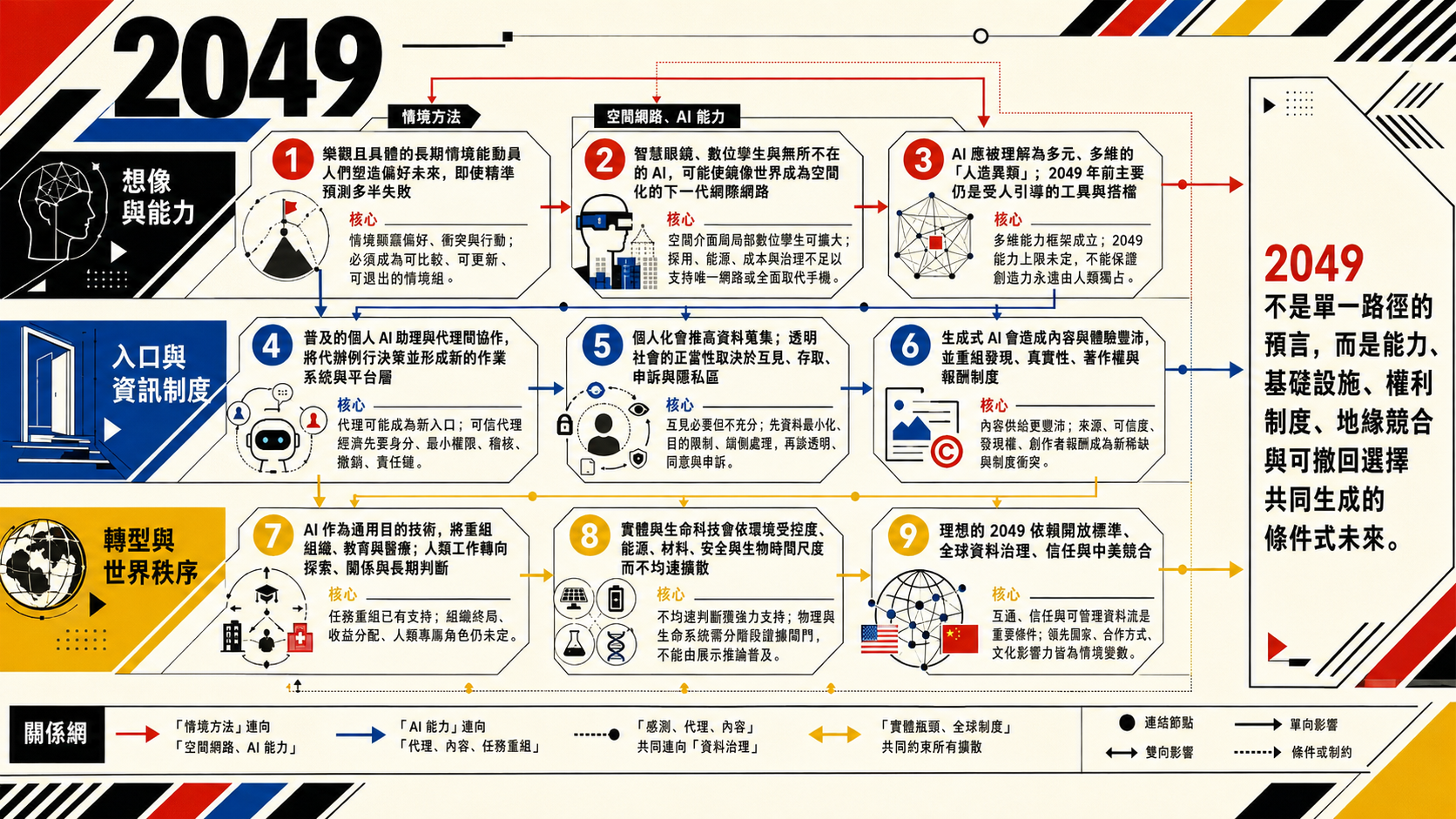 點圖開啟原尺寸
讀完後的三個檢查
九個未來想像的共同結論,不是科技必然抵達某個終點,而是每一條路徑都需要可觀察的訊號、能及時調整的制度,以及定期更新的假設。
情境這是偏好未來、方向判斷,還是可結算預測?
證據哪些領先訊號會提高或降低我的信心?
治理失敗時能否停止、申訴並重新分配責任?
Sources
參考資料
文中的編號可點擊查看;此處保留本篇實際使用的完整來源。
- [1]
凱文・凱利著、吳晨編,《2049:未來10000天的可能》,中信出版集團,2025,ISBN 978-7-5217-7518-1。本文分析之附件版本。
來源為本文分析附件 - [3]
UK Government Office for Science, “The Futures Toolkit,” 2024.
來源 ↗ - [4]
OECD, Foresight Toolkit for Resilient Public Policy, 2025.
來源 ↗ - [5]
Mellers et al., “Psychological Strategies for Winning a Geopolitical Forecasting Tournament,” Psychological Science, 2014.
來源 ↗ - [6]
UK Government Office for Science, “AI Scenarios 2030,” 2026.
來源 ↗ - [7]
Stanford HAI, AI Index Report 2026, 2026.
來源 ↗ - [8]
OECD, Introducing the OECD AI Capability Indicators, 2025.
來源 ↗ - [9]
OECD, Framework for the Classification of AI Systems, 2022.
來源 ↗ - [10]
Brynjolfsson, Rock & Syverson, “The Productivity J-Curve,” American Economic Journal: Macroeconomics, 2021.
來源 ↗ - [11]
NIST, “AI Agent Standards Initiative,” 2026.
來源 ↗ - [12]
NIST, “Accelerating the Adoption of Software and AI Agent Identity and Authorization,” 2026.
來源 ↗ - [13]
NIST, AI 800-4: Monitoring AI Systems in Production, 2026.
來源 ↗ - [14]
OWASP, “Top 10 for Agentic Applications,” 2025.
來源 ↗ - [15]
European Union, General Data Protection Regulation, 2016.
來源 ↗ - [16]
Court of Justice of the European Union, C-394/23 judgment on data minimisation, 2025.
來源 ↗ - [17]
NIST, “Privacy-Preserving Federated Learning” and PETs Testbed, 2025–2026.
來源 ↗ - [18]
NIST, Reducing Risks Posed by Synthetic Content, 2024.
來源 ↗ - [19]
Coalition for Content Provenance and Authenticity, C2PA Technical Specification 2.4, 2025.
來源 ↗ - [20]
U.S. Copyright Office, Copyright and Artificial Intelligence, 2024–2025.
來源 ↗ - [21]
International Labour Organization, Generative AI and Jobs: A Refined Global Index, 2025.
來源 ↗ - [22]
Brynjolfsson, Li & Raymond, “Generative AI at Work,” Quarterly Journal of Economics, 2025.
來源 ↗ - [23]
Noy & Zhang, “Experimental Evidence on the Productivity Effects of Generative Artificial Intelligence,” Science, 2023.
來源 ↗ - [24]
OECD, AI and Skills, 2026.
來源 ↗ - [30]
International Federation of Robotics, “World Robotics 2025—Industrial Robots,” 2025.
來源 ↗ - [31]
International Federation of Robotics, “World Robotics 2025—Service Robots,” 2025.
來源 ↗ - [32]
International Energy Agency, Energy and AI, 2025.
來源 ↗ - [33]
World Health Organization, Human Genome Editing: A Framework for Governance, 2021.
來源 ↗ - [34]
U.S. National Institutes of Health, “Brain-Computer Device Helps Man Speak,” 2026.
來源 ↗ - [35]
International Telecommunication Union, Facts and Figures 2025, 2025.
來源 ↗ - [37]
World Trade Organization, World Trade Report 2025: Making Trade and AI Work Together, 2025.
來源 ↗ - [38]
International Monetary Fund, Geoeconomic Fragmentation and the Future of Multilateralism, 2023.
來源 ↗ - [39]
OECD, “AI Principles,” updated 2024.
來源 ↗ - [40]
OECD, Employment Outlook 2023: Artificial Intelligence and the Labour Market, 2023.
來源 ↗ - [41]
World Intellectual Property Organization, “Artificial Intelligence and Intellectual Property,” accessed 2026.
來源 ↗ - [43]
Hubert et al., “The Current State of Artificial Intelligence Generative Language Models Is More Creative Than Humans on Divergent Thinking Tasks,” Scientific Reports, 2024.
來源 ↗
同系列閱讀
也可以從其他角度繼續閱讀
以下文章彼此獨立,沒有固定閱讀順序;選擇現在最感興趣的角度即可。
Keep Exploring
讀完這一篇,繼續探索下一個問題。
帶著剛剛形成的觀點,看看下一個主題會打開什麼新的視角。